Student decision note
This guide is for general educational planning. It is not legal, tax, medical, mental health, or financial advice. Confirm deadlines, eligibility, and policy details with official sources or qualified professionals before making important decisions.
The Safety Net is Gone: Why 2026 is Different
If you've been ignoring those "Payment Due" emails hoping for another government bailout, it's time to wake up. The "Fresh Start" initiative—that magical one-time amnesty program that let millions of borrowers pull their loans out of default instantly—officially ended on October 2, 2024.
We are now in a new era of student loan enforcement. The training wheels are off.
As of July 1, 2026, the Department of Education is rolling out the One Big Beautiful Bill Act (yes, that's the real legislation signed in 2025), which fundamentally changes how repayment and default work. If you default now, you don't just face the old consequences; you face a system with fewer trapdoors and stricter repayment rules.
Here is the unvarnished truth about what happens when you default in 2026, and exactly how to dig yourself out before the walls close in.
270 Days: The Countdown to Financial Nuclear Winter
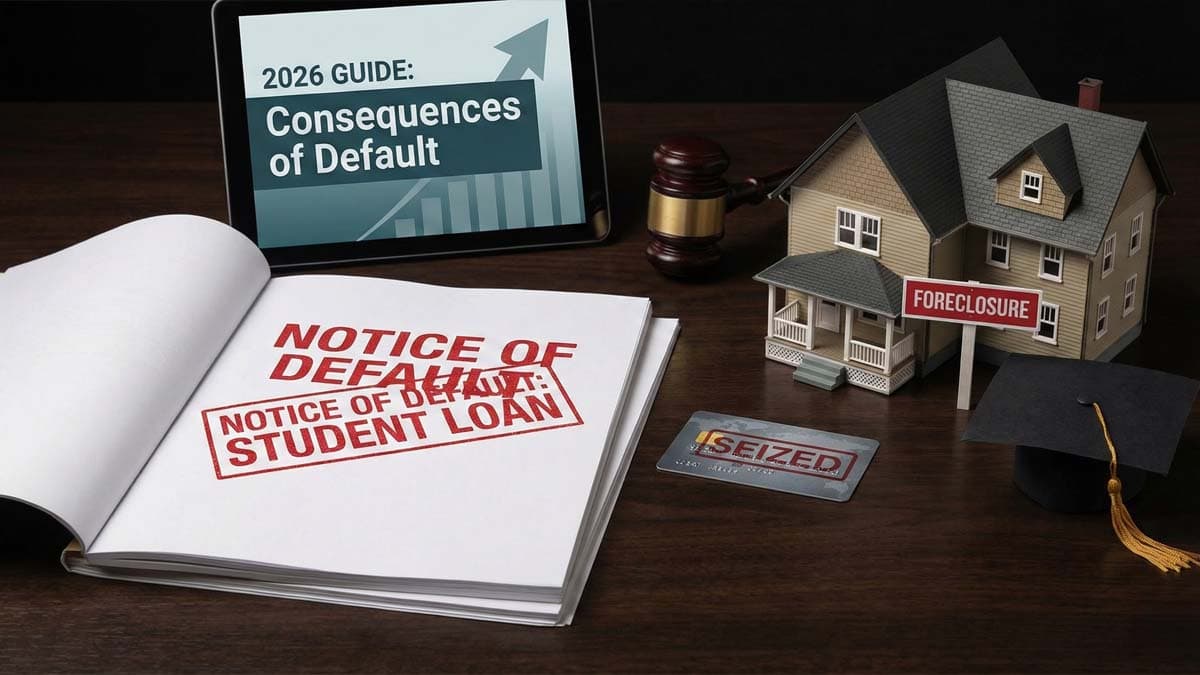
First, let's clarify the terminology. You aren't in default the moment you miss a payment. From Day 1 to Day 269 after a missed payment, you're "delinquent"—late, yes, and your credit score starts to bleed, but you're still in the game. But Day 270 (about 9 months) is when the game changes. That's when default kicks in and the entire balance of your loan becomes due immediately (this is called "acceleration"), and you lose eligibility for all federal aid.
Once you hit that 270-day mark, the government stops asking nicely and starts taking what they're owed.
The "Nuclear" Options: What the Government Can Do to You
Unlike a credit card company, the federal government doesn't need a court order to come after your money. They have "super-creditor" powers that would make a loan shark blush.
1. Wage Garnishment (Up to 15%)
The Department of Education can order your employer to withhold 15% of your disposable pay before it ever hits your bank account. Imagine earning $4,000 a month and having $600 vanish instantly. That's your rent money, your grocery budget, gone. While there have been temporary administrative pauses on involuntary collections in early 2026, these are pauses, not cancellations. Once the machinery restarts, garnishment orders will fly.
2. The Treasury Offset: Seizing Your Tax Refund
Planning to use your tax refund to pay for a vacation or fix your car? Think again. Through the Treasury Offset Program (TOP), the government intercepts your federal (and sometimes state) tax refund and applies it to your defaulted debt. They can take the whole thing.
3. Social Security Seizure
This might seem far off for a 20-something student, but for older students or those receiving disability benefits, the government can garnish up to 15% of Social Security payments.
4. The Credit Score Crater
A default status on your credit report is a financial scarlet letter. It lingers for up to seven years. In 2026, where landlords default to algorithmic screening, a student loan default can automatically disqualify you from renting an apartment, buying a car, or even getting certain jobs (especially in finance or government).
The New 2026 Landscape: The "RAP" Plan
Here is where the 2026 laws change the game. The Repayment Assistance Plan (RAP), introduced under the One Big Beautiful Bill Act, is now the law of the land for new borrowers and the eventual destination for many existing ones.
Why This Matters for Defaulters?
In the past, you could consolidate your defaulted loans and hop onto the SAVE plan with a $0 monthly payment if your income was low. But the SAVE plan is being phased out for new enrollment. The new RAP reality is a minimum monthly payment of $10—it sounds small, but it signals the end of the "$0 payment forever" era. And here's the catch: if you consolidate to get out of default now, you may be funneling yourself into stricter repayment terms depending on when your loans were disbursed.
Getting Out of Default: Your Escape Routes
You're in default. You're panicking. Stop. You have options, but you need to act fast before garnishment starts. Since "Fresh Start" is gone, you're back to the "Old School" methods.
Option 1: Loan Rehabilitation (The "One-Time" Fix)
This is the standard path to redemption. You agree to make 9 reasonable monthly payments (based on your income) within a 10-month period. After the 9th payment, your default status is removed from your credit history—it's like it never happened (mostly). But you can only do this once per loan. If you rehabilitate and default again, this door is locked forever.
Option 2: Loan Consolidation (The Fast Track)
You combine your defaulted federal loans into a new Direct Consolidation Loan. To do this, you generally must agree to repay the new Direct Consolidation Loan under an Income-Driven Repayment (IDR) plan OR make three consecutive, voluntary, on-time, full monthly payments on the defaulted loan before you consolidate. It's faster than rehabilitation (months vs. 10 months), BUT the record of the default remains on your credit report for seven years. You stop the bleeding, but the scar stays.
Option 3: Repay in Full
Pay the entire balance immediately. If you had $30,000 lying around, you probably wouldn't have defaulted. This is rarely a viable option.
The "Tax Bomb" Returns in 2026
For years, student loan forgiveness (via IDR or settlements) was tax-free thanks to the American Rescue Plan. That exemption was set to expire at the end of 2025. Unless fully extended by new legislation in late 2026, any amount forgiven—including interest capped during consolidation—could be treated as taxable income.
Here's the scenario: You have $20,000 forgiven after 20 years. The IRS views that $20,000 as income. You now owe taxes on it. Why care now? Every dollar of interest that accrues while you ignore your default adds to the potential tax bomb waiting for you at the finish line.
Critical Pro-Tips for 2026 Students
1. Don't "Ghost" Your Servicer
Your loan servicer isn't an ex-boyfriend; blocking their number won't make them go away. If you can't pay, call them. They want to put you in deferment or forbearance because it's less paperwork than garnishing your wages.
2. Know the Statute of Limitations (Private vs. Federal)
Federal loans have no statute of limitations—they can chase you until the heat death of the universe. Private loans do have a statute of limitations (varying by state, usually 3-10 years). However, private lenders are much faster to sue you in court to get a judgment before that clock runs out.
3. The "RAP" Math
Under the new Repayment Assistance Plan, payments are 1-10% of AGI (Adjusted Gross Income), you get a $50/month discount per child, and the forgiveness timeline is 30 years (increased from the typical 20/25). Here's a strategic move: if you are eligible for the old IBR/PAYE plans, stay on them as long as legally possible (until the mandatory 2028 switch) to capitalize on better forgiveness terms.
Conclusion: Take Action Now
Defaulting on student loans in 2026 is exponentially more dangerous than it was just a few years ago. The safety nets are being rolled up, and the enforcement mechanisms are coming back online.
If you are 270 days behind, or getting close, submit a Rehabilitation Agreement today. Don't wait for the wage garnishment letter to land in your HR department's inbox—because by then, it's often too late to stop the first paycheck deduction.
You are not a bad person for struggling with debt. But you will be a broke person if you ignore it.
Disclaimer: I am an educational journalist, not a financial advisor or lawyer. Student loan laws change rapidly (as seen with the One Big Beautiful Bill Act). Always verify your specific status at StudentAid.gov.
Official Resources to Verify
Rules and eligibility can change. Use these official resources to confirm details before making important student, financial, health, or safety decisions.
Enjoyed this article?
Share it with your friends and classmates.