Student decision note
This guide is for general educational planning. It is not legal, tax, medical, mental health, or financial advice. Confirm deadlines, eligibility, and policy details with official sources or qualified professionals before making important decisions.
Introduction: The "Free Lunch" vs. The "Tab"
Imagine this: You and a friend go out to dinner every night for four years.
For your friend, a rich uncle (let's call him Uncle Sam) picks up the check every single time. Your friend eats, leaves, and doesn't worry about the bill until four years later.
For you, the waiter just adds the bill to a running tab. Not only that, but the restaurant charges you interest on every burger you ate freshman year. By the time you graduate, your friend owes exactly what the menu said. You? You owe the menu price plus about $1,500 in accrued interest that has now been glued onto your bill forever.
This isn’t a dining analogy; this is the brutal reality of Subsidized vs. Unsubsidized Student Loans.
If you are reading this, you probably have a Financial Aid Award Letter sitting in your inbox (or crumbled in your backpack) full of confusing acronyms. You see "Direct Subsidized" and "Direct Unsubsidized" and assume they are basically the same thing.
They are not.
Mistaking one for the other is one of the most expensive mistakes a college student can make. In this comprehensive guide, we are going to break down exactly what these loans are, run the terrifying math on interest capitalization, and show you how to game the system to save thousands of dollars before you ever walk across the graduation stage.
Part 1: The Core Difference (The 30-Second Summary)
Before we get into the nitty-gritty of federal regulations and interest rates, let’s establish the fundamental difference. It all comes down to one question: Who pays the interest while you study?
Direct Subsidized Loans
The "Golden Ticket"
- Who is it for? Undergraduate students with demonstrated financial need.
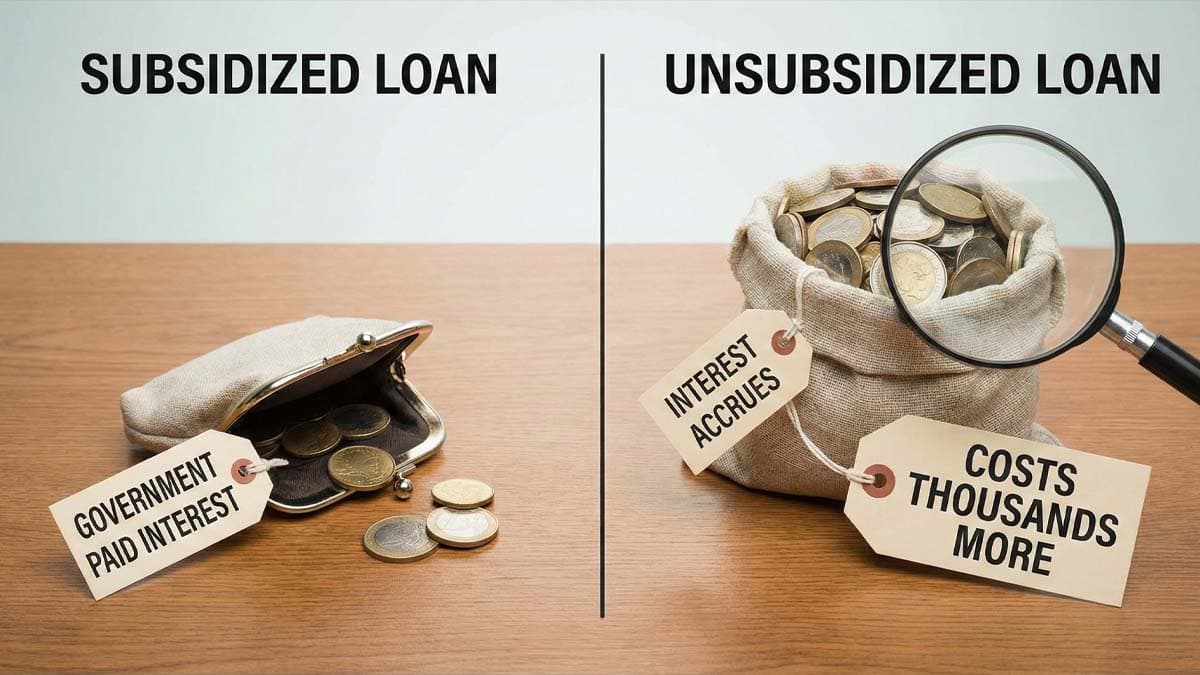
- The Superpower: The U.S. Department of Education pays the interest on the loan while you are in school at least half-time, for the first six months after you leave school (your grace period), and during a period of deferment.
- Translation: If you borrow $3,500 freshman year, you owe exactly $3,500 when you graduate. It is effectively an interest-free loan for four years.
Direct Unsubsidized Loans
The "Standard Pass"
- Who is it for? All eligible undergraduate and graduate students. There is no requirement to demonstrate financial need.
- The Catch: You are responsible for paying the interest on the loan during all periods.
- Translation: Interest starts ticking the second the school receives the money. Even while you are sitting in Biology 101, your loan is growing. If you don't pay that interest, it gets added to the principal balance later.
Why does this matter? Because most students have a mix of both. Knowing which is which allows you to prioritize which ones to accept and which ones to pay off first.
Part 2: The Numbers Game (2025-2026 Interest Rates)
You might think, "Eh, interest can't be that bad."
Let’s look at the current landscape. As of the 2025-2026 academic year, interest rates are sitting at levels that make ignoring them dangerous.
The Current Rates
- Undergraduate Direct Subsidized: 6.39% (Fixed)
- Undergraduate Direct Unsubsidized: 6.39% (Fixed)
- Graduate Direct Unsubsidized: 7.94% (Fixed)
Note: These rates are fixed for the life of the loan. If you take out a loan today at 6.39%, it stays 6.39% until you pay it off, regardless of what the economy does in 2030.
The Example: A $10,000 Tale of Two Loans
Let’s run a simulation. You take out $5,000 in Subsidized loans and $5,000 in Unsubsidized loans at the start of your freshman year. You stay in school for 4 years (48 months).
Loan A: The Subsidized (Golden Ticket)
- Principal: $5,000
- Interest Accrued Middle of Junior Year: $0 (Uncle Sam paid it)
- Interest Accrued Graduation Day: $0 (Uncle Sam paid it)
- Total Balance at Graduation: $5,000
Loan B: The Unsubsidized (Standard Pass)
- Principal: $5,000
- Interest Rate: 6.39%
- Daily Interest Formula: ($5,000 × 0.0639) / 365 = ~$0.87 per day.
- This doesn't sound like much, right? Less than a coffee?
- Over 4 years, that ~$0.87 per day adds up.
- Total Interest Accrued over 48 months: ~$1,278
- Total Balance at Graduation: $6,278
By simply checking the wrong box or not explicitly understanding the loan type, you just cost your "Future Self" nearly $1,300. That’s a new laptop. That’s a security deposit on an apartment. That’s 200 Chipotle burritos.
And it gets worse.
Part 3: The Silent Killer — Capitalization
If there is one technical term you memorize from this article, let it be Capitalization.
With Unsubsidized loans, you aren't required to make payments while in school. Most students don't. They let the interest pile up on the side, thinking, "I'll deal with that later."
When you graduate and your 6-month grace period ends, the "Capitalization Event" happens. The loan servicer takes all that unpaid interest (the $1,278 from our example) and adds it to your principal balance.
Now, your new principal isn't $5,000. It is $6,278.
Here is why that is devastating: Interest is now charging interest.
- Before Capitalization: You were paying 6.39% interest on $5,000.
- After Capitalization: You are paying 6.39% interest on $6,278.
This is called "compound interest," and while it’s a miracle for your savings account, it is a curse for your debt. Over a standard 10-year repayment plan, this capitalization effect can add hundreds or thousands more to the total cost of the loan.
Part 4: Case Study — Sarah vs. Mike
To truly understand the impact, let's look at two students who borrowed the exact same amount but had different loan types.
Sarah: The Subsidized Saver
- Total Borrowed: $20,000 (All Subsidized)
- Time in School: 4 Years
- Interest Rate: 6.39%
- Balance at Graduation: $20,000
- Monthly Payment (10-Year Plan): ~$226/month
- Total Interest Paid Over 10 Years: ~$7,100
- Total Cost of Loan: $27,100
Mike: The Unsubsidized Unaware
- Total Borrowed: $20,000 (All Unsubsidized)
- Time in School: 4 Years
- Interest Rate: 6.39%
- Interest Accrued While in School: ~$5,112
- Balance at Graduation (Capitalized): $25,112
- Monthly Payment (10-Year Plan): ~$284/month
- Total Interest Paid Over 10 Years: ~$8,900 (calculated on the new balance)
- Total Cost of Loan: $34,012
The Result: Mike pays nearly $7,000 more than Sarah for the exact same education, just because his loans were unsubsidized and he didn't pay the interest while in school.
Part 5: Eligibility & Limits — "Why Can't I Just Get All Subsidized?"
Great question. If Subsidized loans are so much better, why would anyone ever touch an Unsubsidized loan?
Because the government puts strict limits on them. They treat Subsidized loans like a VIP section—limited capacity.
Eligibility: The SAI Factor
To qualify for Subsidized loans, you must demonstrate financial need. This is determined by the FAFSA.
- Cost of Attendance (COA) - Student Aid Index (SAI) - Other Financial Aid (Grants/Scholarships) = Financial Need.
If your family has a high income (and a high SAI), you might qualify for $0 in Subsidized loans. You will only be offered Unsubsidized loans.
The Limits (How Much Can I Borrow?)
Even if you are the neediest student on paper, you are capped. The government doesn't want over-leverage undergraduates.
Dependent Undergraduate Students (Most Common):
| Year | Total Limit | Max Subsidized Amount |
|---|---|---|
| Freshman | $5,500 | $3,500 |
| Sophomore | $6,500 | $4,500 |
| Junior | $7,500 | $5,500 |
| Senior | $7,500 | $5,500 |
| Aggregate | $31,000 | $23,000 |
The Hard Truth: College tuition often costs way more than $5,500 a year. So, a typical Freshman financial aid package looks like this:
- $3,500 Direct Subsidized Loan (The max allowed)
- $2,000 Direct Unsubsidized Loan (To fill the gap)
You usually don't get a choice to take only $5,500 in Subsidized. If you need the full $5,500, you are forced to take the mix.
Independent Students
If you are over 24, married, a veteran, or an orphan, you are considered "Independent." Your limits are higher (up to $9,500 for Freshmen), but the Subsidized limit stays the same. The extra money you can borrow is all Unsubsidized.
Part 6: Graduate Students — The Bad News
If you are planning on Law School, Med School, or a Master’s degree, I have some bad news.
Graduate students are not eligible for Subsidized Loans.
As of 2012, the government cut this benefit for grad students. If you borrow money for a Master's degree, it is 100% Unsubsidized. Not only that, but the interest rate is significantly higher (7.94% vs. 6.39% for undergrads).
This is why graduate student debt often balloons so quickly. A law student borrowing $150,000 is accruing massive interest from Day 1 of their 1L year. By the time they take the Bar Exam, they might already owe $170,000.
Part 7: Strategic Borrowing — The Order of Operations
When you get your financial aid offer, it isn't an "all or nothing" deal. You can choose which loans to accept and how much of them to take.
Follow this strict hierarchy of borrowing to minimize your future pain.
Step 1: Free Money
Always, always, always exhaust these first.
- Pell Grants
- State Grants
- Institutional Scholarships
- Private Scholarships (You never pay these back).
Step 2: Federal Direct Subsidized Loans
If you still need money, take this loan. It is the safest debt you can hold. The interest protections act as a safety net if you struggle to find a job right out of college.
Step 3: Federal Direct Unsubsidized Loans
Need more? Dip into these next. They are worse than Subsidized, but better than Private loans because they still offer federal protections (like Income-Driven Repayment plans and Public Service Loan Forgiveness).
Step 4: Parent PLUS Loans / Private Loans
The Danger Zone. Use these only as a last resort. Private loans often require a cosigner, have variable interest rates that can skyrocket, and offer zero forgiveness options.
Part 8: How to Hack Your Unsubsidized Loans
Okay, you did the math, and you have to take out an Unsubsidized loan to pay for your dorm. You are stuck with the "bad" loan.
How do you minimize the damage?
The "Interest-Only" Strategy
The myth is that you can't pay student loans while in school. The reality is that you should.
You are not required to pay the principal, but you are allowed to pay the interest.
The Hack:
- Log into your loan servicer’s portal (Nelnet, Aidvantage, EdFinancial, etc.).
- Find the "Accrued Interest" amount on your Unsubsidized loans.
- Make a payment for just that amount once a month.
Why? Remember that $5,000 example? If you pay the ~$26 in interest every month, when you graduate, your principal is still just $5,000. No interest capitalizes. You have effectively turned an Unsubsidized loan into a Subsidized one by manually paying the interest yourself.
Can’t afford $26 a month? Pay anything. $10. $5. Even a "Pizza Money" payment helps. If you throw $20 at your loan once a semester, that’s $20 less that gets capitalized and compounds for the next 10 years.
Part 9: What If You Drop Out?
This is the scenario nobody likes to plan for, but statistics show about 40% of undergrads drop out.
If you drop out or drop below "half-time status" (usually less than 6 credits):
- The Clock Starts: Your 6-month grace period begins immediately.
- The Subsidy Ends: Once that 6 months is up, you start getting charged interest on your Subsidized loans, too.
Crucial Warning: If you take a "gap semester" that lasts longer than 6 months, you use up your grace period. When you return to school, you will not get another grace period upon graduation. You will have to start paying immediately after your senior year ends.
Part 10: Advanced Tactics: Forgiveness & Refinancing
Public Service Loan Forgiveness (PSLF)
Both Subsidized and Unsubsidized Direct Loans are eligible for PSLF. If you work for a non-profit or the government for 10 years and make 120 qualifying payments, the remaining balance is forgiven tax-free.
- Strategy: If you are pursuing PSLF, the goal is to pay as little as possible so more is forgiven. In this specific case, paying off interest early might NOT be mathematically optimal.
Refinancing with Private Lenders
You will get offers in the mail to "Refinance your student loans for a lower rate!" BEWARE. If you refinance a federal loan (Sub or Unsub) with a private lender (like SoFi or Earnest):
- You lose the Subsidized interest lack.
- You lose access to PSLF.
- You lose access to Income-Driven Repayment (SAVE, PAYE).
- You lose the ability to pause payments during a national emergency (like the COVID-19 pause).
Rule of Thumb: Do not refinance federal loans unless you have a secure high-income job, zero intention of using forgiveness, and can lock in a significantly lower fixed rate.
Part 11: Frequently Asked Questions (FAQ)
Q: Can I transfer my Unsubsidized loan to a Subsidized one later? A: No. The loan type is fixed at origination based on your financial need for that specific year. However, if your family’s financial situation changes drastically (e.g., job loss), you can ask the financial aid office for a "Professional Judgment" review to see if you qualify for more Subsidized aid in future years.
Q: Does my credit score affect which loan I get? A: No. Federal Direct Loans (both Sub and Unsub) do not check credit history. This is why 18-year-olds with zero credit can borrow thousands of dollars. (Private loans, however, care deeply about your credit).
Q: What is the "Origination Fee"? A: It’s a hidden fee the government takes off the top. Currently, it’s about 1.057% for both loan types. If you borrow $5,500, the school doesn't receive $5,500. They receive about $5,441. You are responsible for repaying the full $5,500.
Q: I have both types of loans. Which one should I pay extra on? A: Always direct extra payments to the Unsubsidized loan first. Since the Subsidized loan is interest-free while you are in school (or if you go back to grad school), the Unsubsidized one involves higher "cost of carry." Eliminate the one that is growing fastest.
Q: Does interest accrue during the summer break? A: Subsidized: No, as long as you are enrolled for the next semester. Unsubsidized: Yes, it never sleeps.
Q: Can I pay off my loans while I'm still in school? A: Yes! There is zero penalty for prepayment. In fact, it is the smartest thing you can do. Every dollar you pay now is a dollar that won't compound for the next decade.
Conclusion: Don't Let the "Default" Be Your Default
Student loans are designed to be frictionless. You sign a Master Promissory Note (MPN), click a few buttons on a university portal, and money appears. It feels like magic.
But borrowing money is not a transaction with the university; it is a contract with your future self.
When you accept a Subsidized loan, you are accepting a helping hand—a fair deal designed to get you through school. When you accept an Unsubsidized loan, you are accepting a ticking clock.
Both are tools. Both can be useful. But like a power saw, one is safe to handle, and the other will cut your finger off if you aren't paying attention.
Steps for Today:
- Log in to your Federal Student Aid (FSA) dashboard or your University One.
- Identify exactly how much of your debt is Unsubsidized.
- Calculate the monthly interest accretion.
- Set up a small auto-pay (even $10/month) to fight the capitalization monster.
Your future self (and your wallet) will thank you.
Official Resources to Verify
Rules and eligibility can change. Use these official resources to confirm details before making important student, financial, health, or safety decisions.
Enjoyed this article?
Share it with your friends and classmates.

