Student decision note
This guide is for general educational planning. It is not legal, tax, medical, mental health, or financial advice. Confirm deadlines, eligibility, and policy details with official sources or qualified professionals before making important decisions.
You open your financial aid offer letter. There, nestled between the Pell Grant and the terrifying Direct Unsubsidized Loan, is a line item that looks like a gift: Federal Work-Study (FWS) - $3,000.
Your pulse quickens. That’s $3,000 slashed off your tuition, right? Or maybe a check the government sends you just for existing?
Wrong.
In the lexicon of financial aid, "Work-Study" is the most misunderstood term. It isn’t a grant, and it certainly isn't a handout. It is, essentially, a VIP voucher that gives you exclusive access to a specific pool of on-campus jobs. But here’s the kicker: You still have to find the job, work the hours, and earn the paycheck like everyone else.
For the 2026-2027 academic year, the stakes are even higher. With federal funding structures for these programs shifting in July 2026, the landscape of campus employment is changing. So, is that $3,000 "award" actually worth your time, or are you better off flipping burgers at the local fast-food joint for $18 an hour?
Let's dissect the reality of Federal Work-Study in 2026.
1. The Mechanic: How Work-Study Actually "Pays"
The biggest heartbreak for authorized freshmen is discovering that Work-Study does not deduct from your tuition bill.
When the bursar’s office sends your invoice for the Fall semester, that $3,000 Work-Study award will not appear as a credit. You will still owe the full amount.
So, where does the money go?
It goes into your bank account, bi-weekly, just like a normal paycheck.
- The Government's Role: In 2026, the federal government typically subsidizes a portion of your wages (historically 75%, though this ratio varies by institution and is facing legislative pressure to drop to 25% for many schools).
- The School's Role: Your college pays the rest.
- Your Role: You use that cash to pay for "indirect costs"—textbooks, midnight pizza, transportation, or your Hulu subscription.
Pro-Tip: If you absolutely need that money to pay tuition, you must discipline yourself to save every paycheck and manually pay the school. The system will not do it for you.
2. The "Invisible" Superpower: Protecting Your Financial Aid
If the pay is often minimum wage (and it usually is), why bother? Why not work at a high-paying off-campus restaurant?
The answer lies in the FAFSA.
When you fill out the FAFSA for the next year (2027-2028), the government looks at your income to determine how much aid you deserve.
- Regular Income: If you earn $15,000 working at Amazon, the FAFSA formula sees that as "available income" and may reduce your financial aid package, assuming you can contribute more to your education.
- Work-Study Income: The FAFSA asks, "How much of your income was from Federal Work-Study?" You enter that amount, and the formula wipes it from the calculation.
The Takeaway: Work-Study income is "invisible" to the financial aid formula. You can earn that $3,000 without it hurting your eligibility for Pell Grants next year. For students on the borderline of aid eligibility, this is the single best reason to choose FWS over a private job.
3. The 2026 Shift: Why Competition is Heating Up
A major policy change is rippling through higher education starting July 2026. The Department of Education is reducing the federal share of wages for many Work-Study positions.
Previously, the government paid 75 cents of every dollar you earned. Now, many colleges are being asked to cover significantly more of that cost (up to 75% in some cases).
What This Means for You:
- Fewer Jobs: Cash-strapped colleges may reduce the total number of Work-Study slots.
- Higher Selectivity: Departments will be pickier. They won't just hire warm bodies; they want students with skills (Excel, writing, coding).
- The "Ghost" Award: You might be "awarded" Work-Study funds in your aid package but find that no jobs are actually available when you arrive on campus.
Action Item: Do not wait until "Syllabus Week" to look for a job. Log into your school’s student employment portal in July or August. Secure the job before you even pack your bags.
4. The Hierarchy of Campus Jobs: The Gold, The Grey, and The Grind
Not all Work-Study jobs are created equal. Since the pay is usually standardized (often state minimum wage), the value comes from two things: Downtime (time to study) and Resume Power.
🥇 Tier 1: The Golden Geese (High Value)
- Library Desk Attendant: The holy grail. You check out books for 15 minutes, and study for 45. It is essentially getting paid to do your homework.
- Research Assistant: You work directly with a professor. You might be scrubbing data or washing test tubes, but you are earning a letter of recommendation and graduate school leverage.
- Computer Lab Monitor: Often quiet, air-conditioned, and allows for significant study time.
🥈 Tier 2: The Resume Builders (Medium Value)
- Department Receptionist: You answer phones and file papers. You learn "office soft skills" that employers actually like, but you can't really study on the clock.
- Social Media Assistant: You run the Instagram for the "Office of Student Life." Fun, creative, and great for marketing majors, but requires active brainpower.
🥉 Tier 3: The Grind (Low Value)
- Dining Hall Server: Physically exhausting, smells like industrial dish soap, and zero downtime. Unless the pay is significantly higher (sometimes dining services offer bonuses), avoid this if you have FWS.
- Event Setup Crew: Hauling chairs and setting up stages at 11 PM. Good exercise, bad for your sleep schedule.
5. Work-Study vs. Off-Campus: The Showdown
| Feature | Federal Work-Study (FWS) | Off-Campus Job |
|---|---|---|
| Pay Rate | Typically Minimum Wage | Usually Higher ($15-$20+) |
| Hours | Capped (Max 20 hrs/week) | Unlimited (Beware of burnout) |
| Flexibility | High. They must respect your exam schedule. | Low. The manager cares about profit, not your Chemistry midterm. |
| Taxes | Taxable (but FICA exempt if enrolled full-time) | Fully Taxable |
| FAFSA Impact | None (Income is excluded) | Negative (Can reduce future aid) |
| Commute | None (You are already there) | Requires car/bus/Uber |
6. Myths You Need to Ignore
Myth #1: "I have to work the full $3,000 worth."
False. The $3,000 is a limit, not a quota. If you only work enough hours to earn $1,500, that’s fine. The remaining money just disappears back into the federal ether; you don't owe it to anyone, but you also don't get to keep it.
Myth #2: "If I decline Work-Study this year, I can get it next year."
Risky. Financial aid is often "use it or lose it." If you decline FWS this year, the financial aid office might not offer it to you next year because they assume you don't need it. If you're on the fence, accept the award. You aren't forced to get a job if you accept it, but it keeps the door open.
Myth #3: "I can work as many hours as I want."
False. You are strictly prohibited from working during scheduled class times (even if the class is cancelled that day). Most schools cap FWS at 20 hours per week to ensure you remain a "student first."
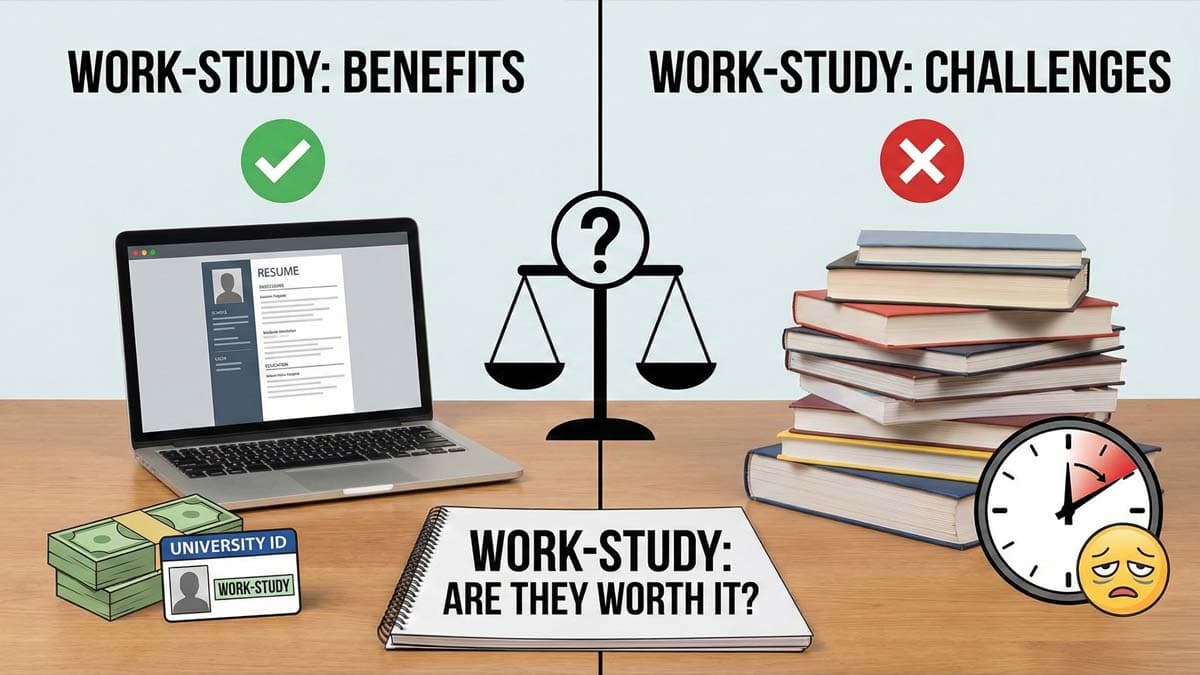
7. The Verdict: Is It Worth It?
Yes, IF:
- You are receiving need-based financial aid (Pell Grants) and want to protect your eligibility.
- You can land a "Tier 1" job that allows you to study while getting paid.
- You value a boss who understands that you need time off for finals week.
- You don't have a car or reliable transportation off-campus.
No, IF:
- You need serious cash to cover rent and tuition gaps (minimum wage won't cut it).
- You have a high-demand skill (bartending, coding, graphic design) that pays double off-campus.
- The only jobs left are 6:00 AM dining hall shifts that will ruin your academic performance.
Final Action Plan
If you choose Work-Study, treat the job hunt like a real corporate search.
- Accept the Award in your financial aid portal immediately.
- Polish your resume. Yes, even for a library job.
- Apply in August. The cushy desk jobs are gone by the first day of class.
- Ask about "academic fit." When interviewing, ask the supervisor: "Do students typically have downtime to study during slow periods?" Their answer will tell you everything you need to know.
Work-Study isn't a jackpot, but used correctly, it’s the smartest financial safety net on campus. Getting paid to read your Biology textbook? That’s not just work; that’s strategy.
Official Resources to Verify
Rules and eligibility can change. Use these official resources to confirm details before making important student, financial, health, or safety decisions.
Enjoyed this article?
Share it with your friends and classmates.

