Student decision note
This guide is for general educational planning. It is not legal, tax, medical, mental health, or financial advice. Confirm deadlines, eligibility, and policy details with official sources or qualified professionals before making important decisions.
It starts with a phone call. Your car transmission just blew up ($1,200). Your laptop screen is shattered ($400). Your medical deductible is way higher than you thought.
Suddenly, you are staring at a math problem that ends with you dropping out of college.
But here is the secret most students ignore: Colleges have rainy day funds.
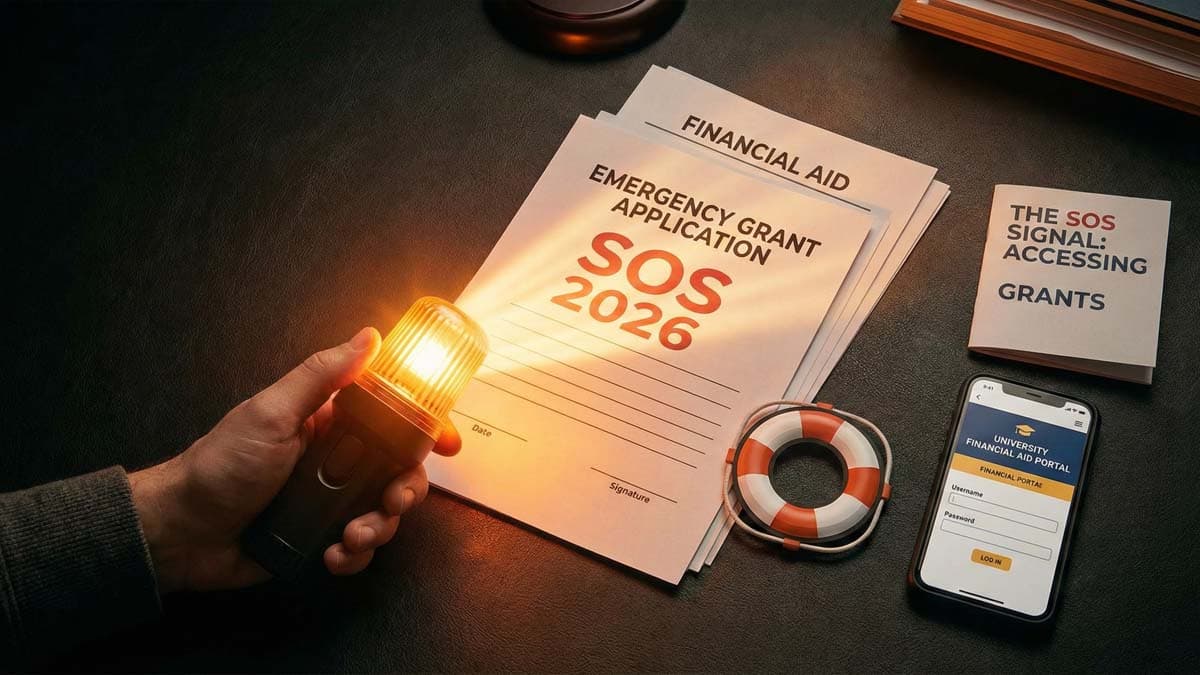
They are called Emergency Financial Aid Grants, and unlike student loans, they don't need to be paid back. In 2026, with the massive federal COVID-era buckets (HEERF) long dry, these funds are now institutional, localized, and highly competitive.
If you are facing a genuine crisis, you don't just "ask" for help. You have to build a case. This is your guide to navigating the emergency aid system when you have $0 and a deadline.
1. The Landscape: What Replaced HEERF?
First, a reality check. In 2020-2022, the federal government sent billions to colleges to pass directly to students (HEERF). That money is gone.
In 2026, emergency aid comes from:
- Institutional Endowments: The college’s own donor funds.
- Student Governments: SGA often manages a small crisis budget.
- State-Level Grants: Programs like Maryland’s "Guaranteed Access Grant" or California’s "Emergency Child Care Bridge."
- Private Non-Profits: Organizations like UNCF, Scholarship America, and Achieve Atlanta that partner with schools to fill gaps.
The Golden Rule: These funds are for emergencies, not poor planning. They won't pay for your spring break trip or the tuition bill you ignored for three months. They are for the "unexpected and unavoidable."
2. What Qualifies as an "Emergency"?
Financial Aid administrators are gatekeepers. They are looking for specific keywords that signal "retention risk" (i.e., if we don't help this student, they will drop out).
Green Light Scenarios (High Approval):
- Housing Insecurity: You are about to be evicted or are currently homeless.
- Medical Crisis: An uninsured procedure or sudden hospitalization.
- The "Work-Stopper": Your car broke down (and you commute) or your laptop died (and you're a CS major). These are tools required to stay enrolled.
- Safety: You need to flee a domestic violence situation.
Red Light Scenarios (Automatic Denial):
- Credit card debt from lifestyle spending.
- Parking tickets.
- "I just didn't save enough for tuition."
3. The Evidence Locker: Receipts or It Didn't Happen
Before you send a single email, gather your proof. In 2026, digital documentation is everything. A vague "I'm struggling" email will get deleted. A PDF-packed dossier gets processed.
The "Crisis Portfolio" Checklist:
- The Bill: The mechanic’s invoice, the eviction notice, the medical bill (EOB).
- The Gap: A screenshot of your bank account balance showing you physically cannot pay it.
- The Income Loss: A termination letter from your employer or a sequence of paystubs showing a sudden drop in hours.
- The FAFSA: Ensure your 2026-2027 FAFSA is on file. Most schools require this to verify you aren't secretly wealthy.
4. The Request: How to Write the Perfect Email
Financial aid officers are overworked humans. They don't want a sob story; they want a problem statement and a solution.
Use this template. It is professional, concise, and hits every required data point.
Subject: URGENT: Emergency Aid Request - [Your Name] - ID: [Student ID #]
To: [Name of Financial Aid Director or specific Emergency Aid contact]
Dear [Name],
I am writing to respectfully request an Emergency Financial Aid Grant to prevent a disruption in my enrollment for the Spring 2026 semester.
The Emergency: On [Date], my [Car/Laptop/Health] suffered a critical failure [describe situation briefly, e.g., "my transmission failed"]. This was an unforeseen expense of $1,400 that is essential for me to [commute to class/complete my coursework].
The Financial Gap: Does not include tuition, I have exhausted my current financial aid package and my part-time income covers only my basic rent/food. I currently have $42.00 in my checking account (screenshot attached).
The Request: I am requesting a one-time grant of $1,400 to cover the repair invoice attached. This aid will allow me to remain enrolled and maintain my current 3.6 GPA.
Documentation Attached:
- Mechanic’s detailed invoice ($1,400).
- Bank statement snapshot.
- Current semester course schedule.
I have explored other options (asked family, looked for extra shifts) but have no other recourse at this time. Thank you for your time and advocacy.
Sincerely,
[Your Name] [Phone Number]
5. Beyond the School: The "Shadow Network" of Aid
If your school says "No" (or "We’re out of money"), do not quit. Pivot to the external network.
A. The "Benevolent" Pivot
Go to your Dean of Students or Department Head. Academic departments often have small discretionary funds for their "star students."
- Script: "Professor, I'm loving this major, but a financial crisis is forcing me to consider withdrawing. Is there any departmental support available?"
B. The Non-Profit Cavalry
- Scholarship America: Check their "Emergency Grants" portal. They often distribute funds for corporate partners.
- UNCF (United Negro College Fund): If you are at an HBCU or a member institution, their emergency retention grants are legendary (up to $1,000).
- Local Community Action Agencies: Every county in the U.S. has a CAA. They have federal block grants to help low-income residents with rent and heat.
6. The "Prevention" Strategy
If you get the grant, treat it like a winning lottery ticket.
- Send a Thank You Note. Seriously. It goes into your file. If you need help again next year, they will remember you as the grateful, professional student.
- Adjust Your Refund Strategy. If you get a financial aid refund check next semester, save $500 immediately. That is your self-funded emergency grant for next time.
The Bottom Line: Emergency aid is not a right; it is a lifeline. It requires humility to ask for, but precision to secure. Treat your application like a legal case. Prove the hardship, show the cost, and demonstrate the ROI (you graduating).
In the economy of 2026, resourcefulness is just as important as your GPA.
Official Resources to Verify
Rules and eligibility can change. Use these official resources to confirm details before making important student, financial, health, or safety decisions.
Enjoyed this article?
Share it with your friends and classmates.


